Awards & achievements within the HCNS network
Best MD and PhD Thesis award 2026
Dr. Sophie Grigutsch
“Effekt von transkranieller Theta-Gamma-Wechselstromsimulation auf motorisches Lernen nach Schlaganfall”
This thesis presents a double-blind, randomized, controlled and pre-registered study, testing whether theta-gamma transcranial alternating current stimulatino (tACS) over the primary motor cortex improves motor skill acquitision in individuals with a stroke and healthy young adults.
Theta-gamma phase-amplitude coupling is a pattern of electrical activity in the cerebral cortex linked to explicit learning and memory. Recent evidence suggests that tACS in a rhythm tha imitates theta-gamma coupling can improve motor skill acquisition. This lead to the idea of using in a stroke rehabilitation.
The study’s primary outcome was negative. Theta-gamma tACS deteriorated skill acquisition during a thumb movement task in individuals with a stroke and did not significantly affect it in healthy individuals. The acceleration of the thumb, however, was increased, but only in the healthy. The results show that theta-gamma tACS can increase acceleration but not motor skill acquisition in general and suggest that age and stroke lesions relevantly influence the effects of tACS.
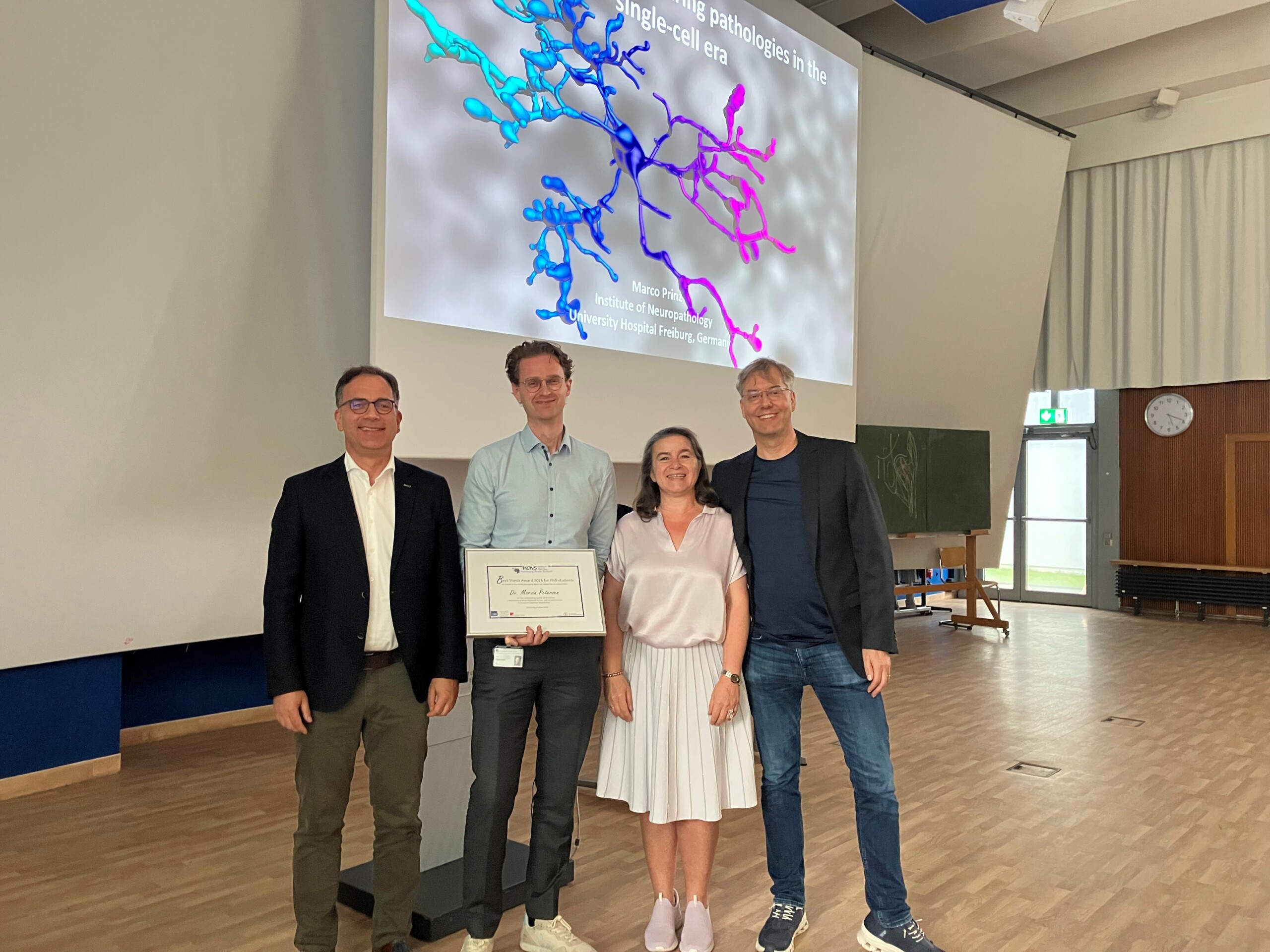
Dr. Marvin Petersen

“Alterations of Brain Network Macro-and Microstructure in Vascular Cognitive Impairment””Alterations of Brain Network Macro-and Microstructure in Vascular Cognitive Impairment”
Vascular cognitive impairment (VCI) is a leading cause of cognitive decline and dementia, yet its underlying mechanisms remain insufficiently understood and clinically actionable biomarkers are lacking. A central challenge is that vascular brain injury is inherently complex, spanning multiple spatial scales from cellular alterations to large-scale network disruption, whereas current diagnostic frameworks rely on coarse imaging markers that fail to capture this complexity and therefore offer limited predictive value. As a result, clinicians are currently unable to reliably determine which patients with cerebrovascular disease willdevelop cognitive impairment. My dissertation addresses this gap by conceptualizing VCI as a brain network disorder and systematically investigating how vascular pathology affects brain structure and cognition across macro- and microstructural levels using large-scale, multimodal neuroimaging.
Across three complementary studies, my work establishes a multi-scale, network-based framework linking vascular risk and injury to cognitive dysfunction. First, in a population-based sample of 40,087 individuals, we identifed a latent clinical anatomical dimension that linked metabolic syndrome to a specific pattern of brain morphological alterations and cognitive performance. Moving beyond traditional univariate approaches, this analysis demonstrated that vascular risk factors jointly map onto a coordinated pattern of cortical and subcortical changes, which in turn mediate their association with cognition. By integrating imaging transcriptomics and connectomics, this study further showed that these alterations preferentially affect regions defined by specific cellular compositions and network-topological properties. This provides novel evidence suggesting that vascular risk links to brain morphological differences in a spatially structured and biologically interpretable manner, rather than being diffuse or unspecific. Second, leveraging multicenter data from 3,485 memory clinic patients, my dissertation demonstrates that network disconnection, not cerebrovascular lesion burden, drives cognitive impairment in VCI. Using lesion network mapping, we show that disconnectivity profiles derived from white matter lesions outperform conventional lesion volume measures by a factor of 3–7 in predicting cognitive performance. Importantly, cognitive deficits localize to disruptions of specific large-scale systems, particularly attention networks. This addresses the long-standing clinical-radiological paradox in cerebral small vessel disease and contributes to establishing disconnectivity as a quantitative and clinically relevant biomarker, advancing individual-level prediction. Third, my work extends the network-based perspective to COVID-19 by demonstrating that individuals recovering from mild SARS-CoV-2 infection exhibit persistent microstructural white matter alterations consistent with neuroinflammatory processes. These alterations are widespread, biologically meaningful in magnitude, and detectable with high diagnostic accuracy, yet occur in the absence of overt cognitive deficits. This finding suggests that subtle vascular-inflammatory mechanisms may induce subclinical network-level brain changes, linking COVID-19 to pathways relevant for VCI.
Taken together, this dissertation makes three key contributions to the field: 1) It provides evidence that vascular risk and injury affect the brain in coordinated, network-specific patterns, rather than as diffuse damage. 2) It demonstrates that brain network disconnection is a superior predictor of cognitive impairment compared to conventional lesion metrics, offering a concrete path toward improved diagnostics. 3) It establishes a multi-scale imaging framework that integrates brain macrostructure, microstructure, and network organization to bridge vascular pathology and cognition. By unifying these insights, this work advances VCI research from descriptive imaging markers to mechanistically grounded, predictive biomarkers that provide a foundation for future validation in risk stratification, prognosis, and targeted intervention.